
The Science of Body Transformation
Understand.
Apply.
Make progress.
A clearer way to approach training and nutrition. Read the science, work through the tools, and build a routine that makes sense to you.
Subscriptions open soon. Join the waitlist to get notified.
02 / THE APPROACH
Less guesswork.
More understanding.
The book is the starting point. The tools help you turn what you read into decisions about your own training and nutrition.
The foundations.
Then the finer details.
Energy balance, resistance training, recovery, and the habits that hold it together.
Explore the free preview
03 / THE WEB COMPANION
It’s a book.
And a place to work.
Real tools, connected to the lessons. Explore the workspace or try the live calculator below.
THE EAT WORKSPACE
Numbers you can use.
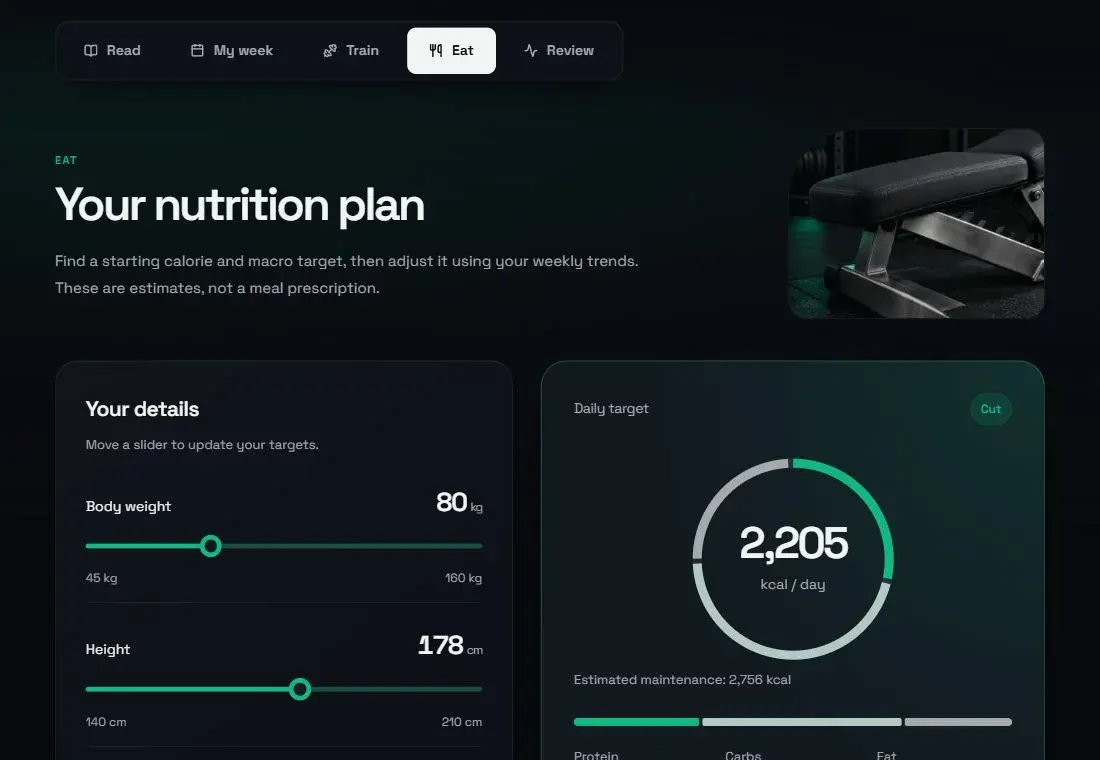
Add food-label amounts and explore educational energy-model examples. No prescribed intake or portions.
Open food-energy toolsActual application interface. Sample local inputs; not customer results.
TRY IT HERE
Your starting point.
Calculated from your inputs.
Use this educational estimate as a starting point, then adjust using your trends. This calculator uses the male Mifflin–St Jeor equation.
Open the full nutrition workspaceEnergy estimate
Educational estimates for adults, not a diagnosis or a prescribed diet or lifting load. Enter values within the stated limits. Do not use calorie targets for children, pregnancy, breastfeeding or treatment of an eating disorder.
Calculated results
04 / THE READING LIBRARY
A clear path.
Thirty chapters deep.
The Truth About Fat Loss
Debunking fitness myths and understanding the deep physiology of body composition.
The BMI & Body Composition Paradigm
Understand the limits of BMI and body-composition measurements without treating a percentage as a health verdict.
Mastering Energy Balance
A massive breakdown of your metabolic engine (BMR, NEAT, TEF, EAT).
The Macronutrient Masterclass
Deep dive into muscle protein synthesis, glycemic index, and essential fatty acids.
The Math of Fitness
Explore energy-model assumptions and food-energy arithmetic without selecting a personal diet.
Hypertrophy & Training Architecture
The science of mechanical tension, metabolic stress, and muscle damage.
Recovery, Sleep, & Supplementation
Practical education, individual limits and linked health references.
The 90-Day Execution Plan
How to phase your diet, periodize training, and build psychological resilience.
Cravings, Eating Patterns and Getting Support
Practical education, individual limits and linked health references.
Cardio Protocols & NEAT
Zone 2 vs HIIT, the interference effect, and why walking is your secret weapon.
Advanced Periodization
Breaking plateaus, understanding RIR/RPE, and structuring effective mesocycles.
Mobility & Longevity
Training for life. Joint health, mobility vs flexibility, and injury prevention.
Advanced Muscle Fiber Recruitment
Targeting fast-twitch vs slow-twitch fibers for maximum hypertrophy.
Hydration and Electrolytes for Training
General hydration context, the limits of symptom interpretation, and questions for individual advice.
Hormones: Context, Not Self-Treatment
The limits of self-assessment, general sleep guidance, and questions for an appropriate healthcare professional.
Nutrient Timing Strategies
Pre, intra, and post-workout protocols for maximizing recovery.
Gut Health and Digestion
The microbiome's role in nutrient absorption and fat loss.
The Art of the Deload
Preventing CNS fatigue and overtraining to break through plateaus.
Isometric and Eccentric Overload
Advanced training techniques for plateau busting and strength gains.
Fuel Use and Metabolic Health
Carbohydrate vs fat oxidation, insulin sensitivity, and maintaining metabolic health through training.
Injury Management & Working With Clinicians
Recognising the limits of self-assessment, preparing questions for clinicians, and discussing return to training.
Biomechanics of the Big Three
Perfecting the Squat, Bench, and Deadlift for your specific anatomy.
Fasting: Evidence and Limits
The limits of general fasting advice, medical cautions and questions about meal timing.
The Psychology of Discipline
Building habits that outlast motivation and creating an unbreakable mindset.
Travel and Fitness
Maintaining progress, managing nutrition, and training while on the road.
Supplement Audit: Evidence vs Marketing
Evidence tiers for sports supplements: creatine, caffeine, protein, electrolytes, and debunked products.
Bloodwork and Health Biomarkers
Understanding laboratory reports and their limits, following actual test instructions, and discussing results with a clinician.
Event Preparation Without Extreme Measures
Event logistics, body-image pressure, privacy and avoiding unsupervised body-manipulation routines.
Aging and Muscle Preservation
Sarcopenia prevention, joint longevity, and training across decades.
The Next Decade of Fitness
Setting long-term goals and maintaining the elite physique for life.
A REFERENCE YOU CAN RETURN TO
Understand the why.
Improve the how.
Research explained in plain language, with sources you can explore for yourself.
Read the referencesChecking your account access…
Who is this guide for?
Beginners and early intermediates who want a structured gym and nutrition starting point instead of piecing together advice from social media. If you can access a standard commercial gym with a barbell, rack, bench, and dumbbells, you have everything you need.
Is this a PDF or a website?
It's an interactive website you read in your browser, on your phone or computer. There's no PDF download.
What equipment do I need?
A barbell, squat rack, flat bench, and a set of dumbbells. Any standard commercial gym has this equipment. The guide does not require cables, machines, or specialised gear — though it explains when they can help.
Do I need prior fitness knowledge?
No. The guide starts from first principles and builds up, so it works whether you are starting out or already training. Each chapter states its assumed background up front.
Is this a coaching program?
No. This is a self-guided educational reference — not a personal coaching service. It gives you a structured starting framework with calculators and checklists, but it does not include one-on-one feedback, custom programming, or ongoing check-ins.
Who wrote this?
Omar Abdoh, an independent fitness author. He is not a certified trainer or registered dietitian — he spent years reading peer-reviewed exercise science and compiled the findings into one structured guide. Every chapter cites its sources, and the guide includes a medical disclaimer recommending you consult a qualified professional.
Can I purchase access now?
Not yet. Subscriptions open soon. Join the waitlist and we'll email you when they do.
What interactive tools are included?
Educational energy-model examples, food-label arithmetic, knowledge checks, flip cards, checklists, workout logging and weekly reflection tools. These are not medical assessments or personalised prescriptions.
Does it work on my phone?
Yes. The layout is fully responsive and every interactive element works on touch, mouse, and keyboard. Reading progress syncs when you sign in.
Is this medical advice?
No. The material is educational and based on published exercise and nutrition science. Consult a qualified healthcare professional before changing your diet or training, particularly if you have an existing condition.
How is this different from free fitness information online?
Unlike scattered blog posts and social media tips, this is a structured curriculum that builds knowledge progressively. Chapters cite specific studies, the interactive tools help you explore starting estimates, and the workout split and grocery guide give you an actionable week-one plan.